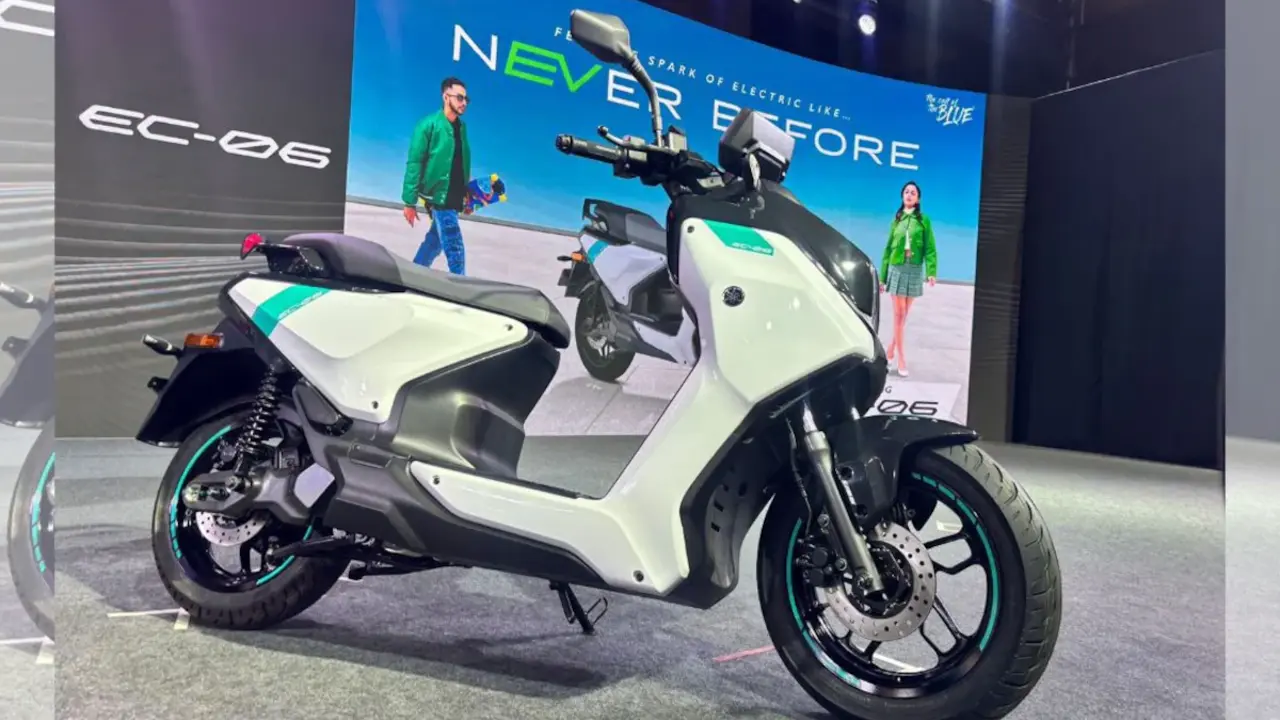
When Yamaha unveiled two new electric scooters in India on November 11–12, 2025, I noticed one headline that spread fast: “Yamaha EC-06 runs 106 km on just ₹15 charge.” That sounded amazing, but it mixed facts from two models. In this post I’ll break down what Yamaha actually announced, explain the math behind the “₹15” claim, and show you the real specs for the Yamaha EC-06 Electric Scooter.
What Yamaha actually announced
Yamaha’s global press release and Indian media coverage confirmed that the company unveiled two production-focused electric scooters for India: the EC-06 and the Aerox-E. These were shown on Nov 11–12, 2025. River Mobility is the production partner for the EC-06 — Yamaha handled the design and engineering while River manages manufacturing.
Important correction: the certified 160 km range belongs to the EC-06, not the 106 km figure. The 106 km number applies to the Aerox-E. Also, Yamaha has not published any official statement saying the EC-06 charges for exactly ₹15 — that figure is an illustrative electricity-cost calculation that depends on local power rates.
Key specs and features of the EC-06
Here are the most important, confirmed facts about the Yamaha EC-06 Electric Scooter you should know:
- Battery: fixed 4.0 kWh pack.
- Motor: roughly 4.5 kW continuous, ~6.7 kW peak.
- Certified range: ~160 km (IDC cycle).
- Charging: full charge from a standard home socket takes about 9 hours.
- Top speed: around 90 km/h.
- Practical features: 24.5 litre under-seat storage, LCD colour display, telematics/SIM connectivity, reverse assist, and front/rear disc brakes.
Those specs show Yamaha aimed the EC-06 at longer urban and inter-urban commuting. The 4.0 kWh battery size is modest but the certified range of 160 km is notable — Yamaha’s claimed efficiency looks strong on paper.
The “₹15 per charge” math — how that number appears
When you see headlines saying “₹15 per charge,” that often comes from a simple formula: cost per charge = battery kWh × electricity rate per kWh + small charging losses. No manufacturer announced a guaranteed ₹15 price for the EC-06; instead, media and readers made sample calculations using local tariffs.
Here are two clear examples so you can see how the math works:
- EC-06: battery = 4.0 kWh. If your electricity rate is ₹3.75/kWh, then cost ≈ 4.0 × 3.75 = ₹15 (plus ~5–10% losses depending on charger and battery).
- Aerox-E: reported dual modules totalling ~6.0 kWh. If your electricity rate is ₹2.50/kWh, then cost ≈ 6.0 × 2.50 = ₹15 (again, not accounting for losses).
Bottom line: ₹15 is a plausible example for certain battery sizes and electricity rates, but it is not an official Yamaha spec for the EC-06. Actual charging cost will vary by state tariff, slab, and how you charge (partial vs full charge).
EC-06 vs Aerox-E: a quick spec comparison
To clear the confusion, here’s a simple table comparing the headline specs of the EC-06 and Aerox-E as reported by Yamaha and Indian auto media.
| Feature | EC-06 | Aerox-E |
|---|---|---|
| Battery | Fixed 4.0 kWh | Removable / dual modules (~2×3.0 kWh reported) |
| Certified Range (IDC) | ~160 km | ~106 km |
| Motor (peak / cont.) | ~6.7 kW peak / 4.5 kW cont. | ~9.4 kW peak (sport focus) |
| Charging Time (home socket) | ~9 hours (full) | Depends on battery modules; removable helps quicker swaps |
| Top Speed | ~90 km/h | Sportier top speed |
| Practical features | 24.5L storage, telematics, reverse, discs | TFT display, multiple ride modes, reverse |
Pricing, availability and practical takeaways
Yamaha did not publish final on‑road prices as of the Nov 12, 2025 announcements. Indian media analysts expect the EC-06 to land around Rs 1.4–1.6 lakh (ex-showroom), with availability likely in Q1 2026 through Yamaha dealers and River Mobility channels. That estimate could change when Yamaha or dealers release official local pricing.
Practical takeaways I want you to remember:
- If you want ~106 km range, look at the Aerox-E — that number applies to it, not the EC-06.
- The EC-06 is claimed at ~160 km — Yamaha positions it for longer daily ranges with a fixed 4.0 kWh pack.
- Charging cost per full charge depends on your local electricity rate. For example, at ₹3.75/kWh a 4.0 kWh EC-06 charge ≈ ₹15; at ₹5/kWh it would be ≈ ₹20.
- Per‑km electricity cost examples: if EC-06 gives 160 km on a 4.0 kWh pack and a full charge costs ₹15, that’s ≈ ₹0.094 per km (about 9.4 paise/km). For Aerox-E with 106 km on a ₹15 charge, that’s ≈ ₹0.142 per km (about 14.2 paise/km).
If you want, I can calculate exact per‑charge or per‑km costs for your state if you tell me your local electricity tariff (₹/kWh) or the state you live in. I can also convert the expected price into USD if that helps you compare internationally.
Also Read: Hero Xtreme 125R 2026 Launched at ₹1.04 Lakh – Full Details and Features Revealed
Final Thoughts
The headlines about “Yamaha EC-06 Electric Scooter: runs 106 km on just ₹15 charge” mixed two scooters and a rough electricity-cost example. The facts are clearer: the Yamaha EC-06 Electric Scooter is quoted with a certified range of around 160 km, a 4.0 kWh battery, about 9 hours to charge from a home socket, and a top speed near 90 km/h. The 106 km and some of the ₹15 math better match the Aerox-E or are illustrative calculations based on local power prices.
I hope this clears the confusion. If you want me to run the exact charging cost for your postcode or convert the likely price into another currency, tell me your state or the per‑kWh rate and I’ll do the math for you.